


We ran the third session in our workplace wellbeing panel discussion series on exactly this question: why do mental health conversations at work still feel so difficult for managers, and what can organisations actually do about it? Our Wellbeing Relationships Manager was joined by two associate trainers, one specialising in leadership skills and mental health first aid, the other in manager support and neurodiversity, to unpack what’s really going on. This blog pulls together the key takeaways.
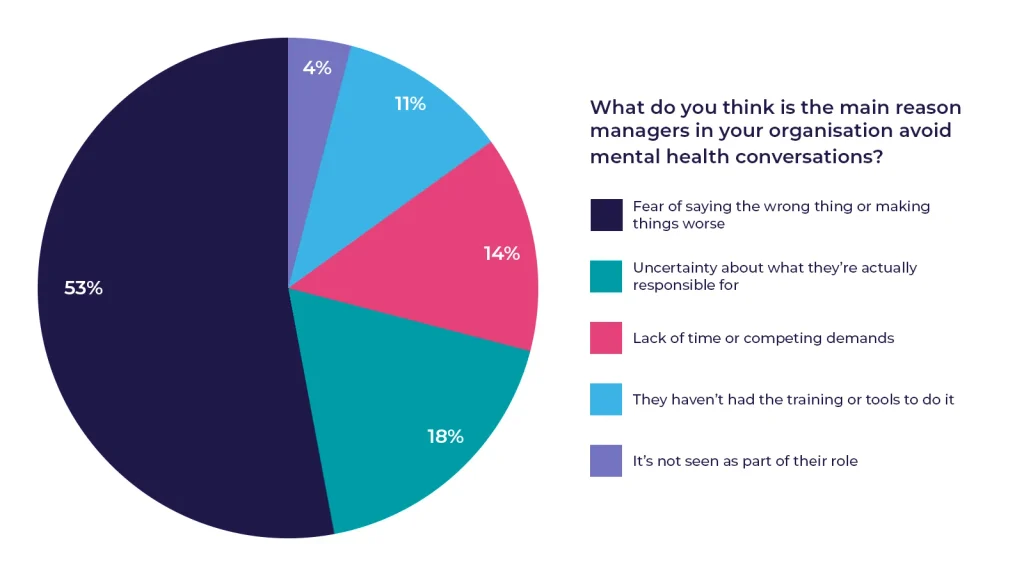
The headline finding from the session’s live poll won’t surprise most HR teams: 53% of attendees said the main reason managers in their organisation avoid these conversations is fear of saying the wrong thing or making things worse, more than three times the next biggest reason, uncertainty about what they’re actually responsible for, at 18%. That single statistic shaped the rest of the discussion, and it’s the right place to start.
Why Managers Avoid Mental Health Conversations at Work
Our panel were clear that this fear cuts across experience level. Brand-new managers and those who’ve been in post for decades report almost identical worries: what do I say, how do I say it, what if someone cries, what if they tell me something distressing, what if I’m overstepping or even breaking the law by asking?
That last one came up repeatedly. Several managers our trainers have worked with were genuinely concerned that asking about an employee’s wellbeing could land them in legal trouble. It can’t, and won’t, provided the conversation stays respectful and consent-based, but the fact that this fear exists at all shows how under-supported many managers feel.
Our panel also pointed out that this isn’t unique to the workplace. Across society, most people avoid conversations about mental health, because the same fear applies everywhere: what if I make it worse? Cultural, religious and neurotype differences all shape how comfortable someone feels starting that conversation in the first place. Managers aren’t failing at something everyone else finds easy. They’re attempting something most people find genuinely hard, without necessarily having been given the tools to do it.
It’s Not About Having the Perfect Script
One of our trainers put it simply: managers can usually open a conversation about mental health at work. Where they get stuck is once they’re in it. They don’t know what to do next, where to signpost, or whether it’s even their job to be having the conversation at all.
That’s not a confidence problem that a script fixes. Our panel were honest that quick-reference guides and conversation prompts have their place, but they’re not the answer on their own. What actually builds confidence is practice: having the conversation, reflecting on how it went, and doing it again. Training gives managers the foundation, but it has to be followed up and reinforced, or it fades within a few weeks of returning to a full inbox.
Confidence Comes From Doing, Not Just Training
Our panel were direct about this: a single day of training, with no follow-up, isn’t going to embed lasting change. Organisations need to think about what happens after the training session, whether that’s refresher sessions, peer support, or senior leaders visibly modelling the same openness they’re asking managers to show. If leadership isn’t practising what it’s asking for, managers notice, and the training doesn’t stick.
From Fixer to Listener: What Employees Actually Want
A second live poll asked attendees what they thought an employee struggling with their mental health wants most from their manager. The result was close to a tie between wanting to be heard without immediate problem-solving, and genuine uncertainty about what’s wanted at all.
That “fixer” instinct came up again and again in the discussion. Managers, like parents, often default to solving the problem the moment someone opens up. Our panel’s advice: resist that instinct. Most people don’t want their manager to fix their mental health. They want to be heard, to know someone has noticed, and to feel that short-term, practical support is available if they need it. The simplest way to find out what someone actually needs is to ask them directly, rather than assuming.
Our panel also flagged that this starts well before any difficult conversation happens. Trust is built in the small, everyday moments: asking how someone’s weekend was and actually remembering the answer, noticing a change in behaviour and checking in early, being honest yourself about having an off day. None of this requires a formal process. It just requires managers to be consistently, visibly human with their teams.
Where a Manager’s Responsibility Begins and Ends
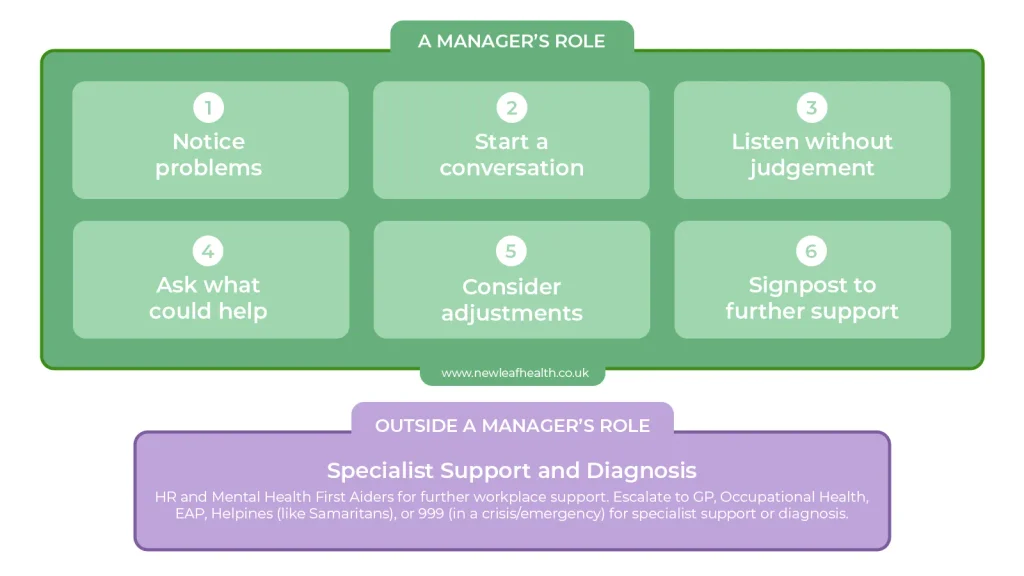
This is one of the most practical takeaways from the session, and one every organisation should be clear about internally. A manager’s role in mental health conversations at work is to notice a change, start a conversation, listen, ask what help someone might need, consider reasonable workplace adjustments, and signpost to further support, whether that’s an Employee Assistance Programme (EAP), occupational health, a GP, or a specific charity.
What a manager is not responsible for is diagnosing anyone. Managers aren’t clinicians, therapists or counsellors, and shouldn’t be expected to act as one. Once a manager has done what’s within their role, the next step is handing over to HR, or whoever holds that responsibility in a smaller organisation, for anything that needs more specialist support.
Building Trust Before You Need It
Psychological safety was one of the themes our panel kept returning to. If an employee doesn’t trust their manager, no amount of training will make that first conversation happen. Our panel’s suggestion for building this proactively: ask new team members (or existing ones, if you’ve never asked) what a bad day looks like for them, and what they need from you on one. Share your own answer too. Those small moments of mutual honesty do more to build trust than any formal policy.
Confidentiality matters here too. Unless there’s a genuine safeguarding concern, what an employee shares with their manager shouldn’t travel further without their consent, not to the manager’s own line manager, and not to HR. Several of our trainers’ clients have lost employee trust precisely because this boundary wasn’t respected.
When an Employee Isn’t Forthcoming
Sometimes a manager notices a change in someone’s behaviour, but the employee isn’t ready to talk about it. Our panel’s guidance here: don’t be afraid to be direct. There’s nothing wrong with naming what you’ve noticed and the impact it’s having, then leaving space for the person to respond in their own time, with a clear plan to check back in.
Importantly, this is a two-way process. The manager’s job is to open the door, consistently and without judgement, not to carry sole responsibility for someone else’s engagement with it. If, after genuine effort and reasonable adjustments, a situation still isn’t improving, it may eventually need to become a different kind of conversation, around performance, rather than wellbeing. Our panel were clear this should always be a last resort, not a first response.
Handling a Mental Health Crisis
A crisis situation, where someone discloses thoughts of suicide or self-harm, is different from an everyday difficult conversation, and our panel were clear that managers shouldn’t be expected to handle it entirely on their own.
The immediate priority is connecting the person to the right support, not managing the situation solo. That might mean contacting Samaritans, texting Shout, calling Mind’s helpline, or using an app like Hub of Hope, which can show local crisis support services by postcode. In an escalating situation, that might mean A&E or a 999 call, or contacting the person’s emergency contact so they’re not alone. NHS 111 can also give advice on next steps.
For organisations wanting to think this through properly rather than improvising in the moment, the British Standards Institution has published formal guidance on this exact issue, BS 30480, Suicide and the Workplace: Intervention, Prevention and Support for People Affected by Suicide, which sets out good practice for prevention, in-the-moment intervention, and supporting a workplace afterwards. It’s not a legal requirement, but it’s a useful framework if your organisation hasn’t yet agreed what it wants managers to do in a crisis. We’d flag this as worth a conversation internally before you need it, not after.
Why This Comes Down to Infrastructure, Not Just Training
Our panel’s strongest message, and the one most attendees said they’d take away, was that training alone doesn’t fix this. A manager who’s completed excellent training will still struggle in a culture where mental health is a taboo subject, where there’s no senior leadership buy-in, and where nobody else is modelling openness.
This echoes a position taken publicly by Mental Health First Aid (MHFA) England, which has long campaigned for mental health first aid training to be made a legal requirement alongside physical first aid, while cautioning that mandating training without the organisational infrastructure to support it won’t deliver a good return on investment. Trained mental health first aiders and confident managers both need an environment that actually uses and values what they’ve learned, or the investment goes to waste.
In practice, that means wellbeing can’t sit as a standalone policy document. It needs to be woven into how the organisation already works: into HSE’s own guidance on managing work-related stress, into how workloads are set, into how senior leaders talk about their own wellbeing, and into the basic expectation that every manager will, at some point, need to have this conversation with someone on their team.
The Business Case for Getting This Right
For any HR or wellbeing lead needing to make this case to the board, the financial argument is substantial. Poor mental health costs UK employers an estimated £51 billion a year, with presenteeism (people at work but not functioning well) the single largest contributor at around £24 billion, according to Deloitte UK, Mental Health and Employers: The Case for Investment, May 2024. This is the most recent UK-wide figure of its kind that we could verify against Deloitte’s own research, and it’s a meaningful improvement on the £55 billion reported in 2021, suggesting workplace investment in this area is already paying off nationally, not just reversing a worsening trend.
Set against that backdrop, giving managers the confidence and support to have mental health conversations at work isn’t a soft, nice-to-have initiative. It’s a direct lever on absenteeism, presenteeism and retention, with a clear and growing body of UK evidence behind it.
Building Your Approach to Mental Health Conversations at Work
The clearest message from this session was that confidence in mental health conversations at work isn’t something you can train into existence overnight. It’s built through practice, reinforced by senior leadership, and supported by the right infrastructure so managers aren’t left figuring it out alone.
Fittingly, the session closed by looking ahead to our next webinar, on menopause and the brain, a topic that sits squarely within the same territory: another area where managers need confidence and the right support to have good conversations. We’ve already written that one up, if you’d like to read our blog on menopause and brain health at work.
If you missed the live session, or want to share it with your management team, catch the full webinar recording and register for future sessions here.