


One of the most important aspects of any workplace wellbeing strategy is information. You can have the greatest wellbeing initiatives in the world, but if you don’t know who’s using them or whether they’re having an impact, you may as well be flushing your budget down the toilet.
And that’s where any employee wellbeing survey comes in. It connects the start and end of your strategy perfectly. It helps you determine what your employees want from your wellbeing programme and, when you reassess later down the line, it tells you how effective your strategy has been.
In this post, we’re going to take a quick look at what a workplace wellbeing survey is, why it’s important, and a list of fifty questions you can ask your employees to help get the information you need.
What is an Employee Wellbeing Survey?
An employee wellbeing survey is pretty much what it says on the tin – a survey you put out to employees to get their input on wellbeing. Specifically, though, it’s wellbeing in relation to your workplace.
That could be how the workplace affects their wellbeing on a day-to-day basis, as well as how their overall wellbeing affects their ability to be at work and get their job done.
Fundamentally, though, the survey should be employee-focused. It’s about determining what they want and need, as well as how they feel at work.
Why the Questions You Ask Matter
The questions you ask in your employee wellbeing survey are incredibly important, not only in subject and topic coverage, but also in quantity.
Every single question you add to your survey is a point of friction. It’s an extra ten seconds or so that the respondent has to spend reading, then maybe another ten seconds considering their answer. You can see how this could add up quickly. So it’s imperative that you keep the quantity of questions to the absolute minimum – don’t skip anything important, but likewise make sure that every single question informs your wellbeing strategy in a meaningful way.
Similarly, the actual format of the question is important, too. In our facilitated employee wellbeing survey, there are only two questions that ask for a text response. Every other question is a multiple-choice or tick box response. Not only does this make the whole survey quick to answer, but it also standardises the data so that it can be easily analysed.
For example, if you asked people to provide a text response to what department they worked in, for HR staff you could get answers like HR, H.R., Human Resources, etc., not to mention the possibility of spelling errors. This means extra work for you when you’re collating the data at the end.
So, in summary, keep questions short, to the point, and multiple-choice where possible. Your employees will thank you for it, and you’ll thank yourself, too.
How to Structure Your Wellbeing Survey
Structuring your employee wellbeing survey logically is crucial for easy answering and reducing that friction we talked about previously. Primarily, we recommend sectioning out your survey to address the key pillars of workplace wellbeing, which are:
- Physical wellbeing
- Mental wellbeing
- Social wellbeing
- Financial wellbeing
Additionally, you’ll want to include a section on demographics at the beginning so that you can cross-reference data: for example, how do home workers rate their social wellbeing versus on-site workers (interestingly, the CIPD found that hybrid working is most conducive to positive mental wellbeing).
It’s also a good idea to include a section at the end on your current wellbeing provision, naming specific initiatives so that you can get direct feedback on them. This is something we do in our employee wellbeing survey, as it helps you understand which services people are aware of and are likely to use, as well as what they might like to have instead – ensuring you utilise your budget effectively.
Choosing Which Areas of Wellbeing to Measure
At the risk of becoming a broken record, brevity is king when it comes to questionnaires and surveys. You’ll want to ask questions that are particularly relevant to your workplace, which is why we recommend sticking mostly to the four main pillars of workplace wellbeing:
- Physical wellbeing
- Mental wellbeing
- Social wellbeing
- Financial wellbeing
Depending on who you ask, there are as many as nine pillars, and these often change depending on who’s talking about it, too. Some of the other pillars include:
- Digital wellbeing: how overall wellbeing is impacted by the use of digital technology.
- Professional wellbeing: to what extent employees are fulfilled in their professional lives.
- Community wellbeing: how well someone engages with their community, be it at work or in a wider sense. This is an offshoot of social wellbeing.
- Environmental wellbeing: another aspect of social wellbeing, this explores how colleagues interact with their immediate environment at work, as well as in a wider sense across the business.
- Emotional wellbeing: a more specific aspect of mental wellbeing that focuses on the emotions of employees.
These are mostly subsets of the four main pillars above, so you can often add related questions to those four categories.
Essentially, if your employee wellbeing survey sticks to the main four areas of wellbeing, you can’t go too far wrong.
Question Types and Rating Scales
If you’ve read this far, you’ll already know the answer, but we’ll say it again for everyone who skipped straight to this section – your questions need to be almost exclusively multiple-choice.
If you’re using a survey builder tool like Microsoft Forms or Google Forms, these are the key types of questions you’ll want to use:
- Multiple choice
- Dropdown
- Rating scale
- Star rating
- Net promoter score (NPS)
- Slider scale
- Matrix choice/likert scale
These are just a few examples. Different survey tools will have their own names for certain types of questions. Ultimately, though, you need to be the one to set the parameters of a question. For example, instead of asking What’s your age? and letting them type a number, give them these options instead:
- Under 18
- 18 – 24
- 25 – 34
- 35 – 44
- 45 – 54
- 55 – 64
- 65+
There wouldn’t really be a situation where you’d need to know someone’s exact age – the banding will be just as good. For example, if you notice that a lot of women in the 45 – 54 bracket report lower wellbeing than women in the other age brackets, you may be able to conclude that menopause symptoms are affecting the wellbeing of this demographic and that it’s time to introduce some workplace menopause support – you don’t need to know someone’s specific age to draw this conclusion.
A note on anonymity – please don’t ask people their names, or any other personally identifying data, for that matter. Not only will this make employees less likely to fill out the survey (they may worry their answers will be scrutinised), but it could present GDPR and privacy challenges, too.
Keep things simple, broad, and multiple-choice.
How Many Questions to Include
With our facilitated employee wellbeing survey service, we ask exactly 27 questions. These run over six separate sections (one for each of the four pillars, plus demographics and the current wellbeing offering pages). 25 of these questions are multiple-choice, with only two offering text responses, and both of these ask the respondent to provide more information on a multiple-choice answer, if they wish to.
This is a fairly comprehensive wellbeing needs analysis survey. It provides actionable data and insight, whilst reducing the friction of responding to an absolute minimum.
Is 27 questions the right amount for your business? It depends. If you’ve never done an employee wellbeing survey before, you might consider reducing it to fewer than 10 questions, just to gather some key data to get started. If your employees are used to taking an annual survey and your completion rates are high, then the sky is your limit!
It’s all about finding a good balance between what data you need and what your staff will realistically be willing to fill out for you. If in doubt, though, start small and build up from there.
Employee Wellbeing Survey Questions by Category
Okay, here’s the part you’ve been waiting for. Here are 28 key questions you can ask as part of your employee wellbeing survey. We’ve split them into the categories we use in our facilitated service so you can easily browse and choose the right ones for your needs.
Demographic Questions
- What is your age? Keep the answers multiple-choice and banded, rather than asking for a specific age, i.e. 45 – 54.
- To which gender do you most identify? Sex at birth isn’t important for this survey, so keep your choices open and inclusive. Make sure you also add a ‘Prefer not to say’ option too.
- Which department do you work in? It’s important to understand which areas of the business may need support, but it’s crucial to respect privacy on this question, too. If you have departments with only a few members of staff, it would be worth merging them so you can avoid identifying the answers of a single-person department.
- Where/How do you work? This is all about location, so typically you’d have choices like office/on-site, work from home, hyrbid, mobile worker, etc.
Physical Wellbeing Questions
- Overall, how would you rate your own physical wellbeing? Nothing scientific here, just a rating from 1 – 5 (very poor to excellent) for how someone perceives their own wellbeing currently.
- Is your physical health limited because of health problems or a disability (including problems related to ageing)? Keep choices to something like A lot, a little, not at all, as you don’t need to dive into specifics.
- Do you smoke? Just a simple yes/no question. For current national health guidance, there isn’t really much benefit to asking about vaping habits in your employee wellbeing survey. Ultimately, if a lot of your staff smoke, you want to help them quit, and the NHS currently suggests that vaping is one of the best tools to help quit smoking, and is significantly safer (though not harmless).
- Do you drink alcohol? Again, a simple yes/no question.
- In an average week, approximately how many units of alcohol do you consume? Keep it simple and in line with national guidance: less than 14 units/more than 14 units. We ask this as a branching question, so it only appears if they respond yes to question 4. Some survey tools allow this, but it depends on which tool you use. It’s also helpful to include a reference point here. We add a footnote to this question: For reference, the average pint of beer/cider is 2 units, a standard glass of wine is 2.1 units, and a 25ml shot of spirit is 1 unit.
- Overall, how would you rate your diet? A simple 1 – 5 scale here works.
- In an average week, on how many days do you undertake moderate or intense physical activity? The NHS guidance is 150 minutes of moderate exercise, but unless you keep track, the best option is rarely, or letting them choose a number from 1 to 7.
Mental Wellbeing Questions
- How would you rate the levels of stress or pressure you experience in your life outside of work? Simple rating from 1 – 5 (very low to very high).
- How would you rate the levels of stress or pressure you experience in your life at work? Again, a simple 1 – 5 rating.
- Overall, to what extent do you feel that the things you do in your life are worthwhile? 1 – 5 rating again (not worthwhile to very worthwhile). This question may seem a bit existential for a simple employee wellbeing survey, but it can help highlight the need for Mental Health First Aiders or even Suicide First Aiders in the workforce, if it highlights a consistent response.
- Overall, how happy did you feel yesterday? A 1 – 5 rating again. The ‘yesterday’ qualifier is key, as it’s highly unlikely that an employee will be able to objectively assess their happiness as an average over the last month or year. It’s designed to realistically capture their current state of wellbeing, both for them and for you.
- Overall, how anxious did you feel yesterday? A 1 – 5 rating, with the same ‘yesterday’ logic as question 4.

Social Wellbeing Questions
- In an average week, how often do you feel socially connected to colleagues and friends at work? A simple 1 to 5 rating (none of the time to all of the time)
- Does your working environment or practice lower your score? If so, what factors contribute to this? This is our first open-ended text question, but it’s an important one, helping to highlight specific social challenges that may occur in the workplace. If your survey tool allows it, feel free to add a character or word limit to the response.
- In an average week, how often do you feel socially connected to family, friends and community outside of work? A 1 to 5 rating. Even though you can’t control social connection outside of work, you can still help to support feelings of loneliness that may emerge. Asking this question on an employee wellbeing survey is a great opportunity to allow people to be honest in an anonymous, judgement-free environment.
Financial Wellbeing Questions
- How would you rate your financial wellbeing at the moment? A 1 to 5 rating (very poor to very strong). You should avoid any mention of salary or benefits in this section of your employee wellbeing survey, as that can open a huge can of worms!
- In an average week, how often do you worry about your personal finance? 1 to 5 rating (none of the time to all of the time).
- How would you rate your knowledge around personal finance in general? 1 to 5 rating (no knowledge to lots of knowledge).
Wellbeing at Work Questions
- Does your employer have a wellbeing strategy/policy in place? Here we go for a more specific multiple-choice answer:
- They have a policy, and I have seen it.
- They have a policy, and I haven’t seen it.
- They don’t have a policy.
- I don’t know.
- How proactive is your employer around wellbeing in the workplace? A simple 1 – 5 (not at all, to very proactive).
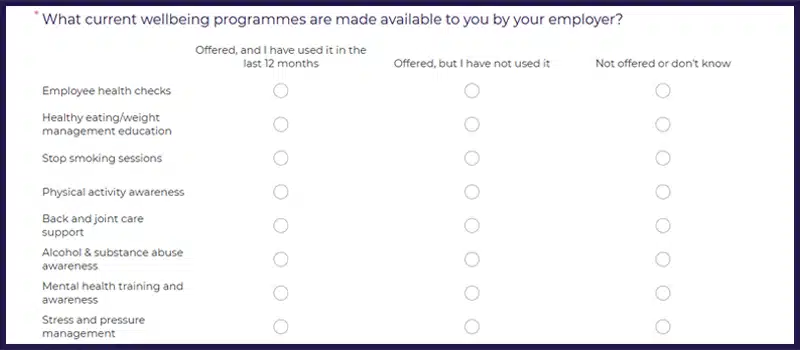
- What current wellbeing programmes are made available to you by your employer? Here, you’ll want to use a likert/matrix grid, listing your programmes/initiatives down the left side (include services you offer, as well as ones you don’t), then across the top options similar to:
- Offered and I have used in the last 12 months
- Offered and I have not used in the last 12 months
- Not offered or don’t know
- What would you like to have available as part of the wellbeing offering in your workplace? List the same options on the left side, but across the top your options should now read:
- Very interested
- Somewhat interested
- Not interested
- Is there anything else your employer should consider when it comes to supporting your health and wellbeing? Here’s our second (and final) open-ended question of the employee wellbeing survey. This is the one where you’re likely to get some hefty opinions, but it’s still a great opportunity to get some important qualitative feedback.
- On a scale of 1 – 10, how likely are you to recommend working here to a friend or family member? Use a net promoter score (NPS) scale for this question. It’s 1 – 10, where 6 or below is treated as a negative response, 7 – 8 is neutral, and 9 – 10 is a positive response – i.e. someone who is likely to promote your company.
Common Mistakes to Avoid when Writing Survey Questions
There are quite a few pitfalls you can face when putting together your employee wellbeing survey. If you want to make sure you’re running a truly neutral and objective survey, you’ll want to reach out to an employee wellbeing survey provider like New Leaf Health, but if you’re going to go it alone, here are some problems you should avoid:
- Loaded questions – avoid biasing the reader in the question. Instead of asking ‘Why do you feel overworked by management?’, ask ‘How manageable is your current workload?’.
- Vague buzzwords – use clear, simple language and avoid corporate buzzwords or fluffy language.
- Meandering questions – don’t overload your questions; stick to one clear topic. For example, don’t ask ‘Do you drink alcohol? And if so, how much?’ Instead, split these into two questions, or consider whether you really need to ask both questions at all.
- Getting too personal – ensure you don’t ask questions that get too personal. Showing an interest in supporting an employee’s personal life is great, but not when it steps over the boundary. For example, asking ‘Do you feel like you can manage your work and personal lives separately?’ is a less invasive question than ‘Do childcare issues stop you from being as productive as you could be?’ The intent may be good, but the question certainly doesn’t sound that way.
- Stay relevant – If you start asking about how much alcohol your employees drink, what types, and when, not only is this too personal, but what if someone doesn’t drink? If you absolutely have to get specific on certain topics, use conditional logic (if your employee wellbeing survey tool allows) to hide questions that aren’t relevant.
- Respect privacy – we’ve already hammered this one home above, but your employee wellbeing survey absolutely has to be confidential. Don’t collect information that could be used to identify anyone.
- Too many questions – the more questions you ask, the weaker your data will be. Respondents will get bored and start clicking anything just to be done with it or, worse still, they won’t complete it at all.
In a nutshell, if you keep your employee wellbeing survey quick, short, relevant, and completely anonymous, you can’t go too far wrong.

What to do with Your Survey Results
So, you’ve completed your employee wellbeing survey – what next? Now you get to turn your data into action! That’s right, building and collecting responses for the survey is barely half of the job. The most important part is doing something about it. So let’s start with reporting.
Analysing and Benchmarking Responses
Key stakeholders will want to know the results of your employee wellbeing survey. Especially if it’s the first time you’ve ever run one. Directors will want to know that budget is being spent well, and your workplace wellbeing champions will want to know if their campaigns are effective. Additionally, your employees may want to know the results, too.
Firstly, you need to get the data into an easy-to-digest format. Here at New Leaf Health, our facilitated employee wellbeing survey sits on a platform with a live dashboard that updates as responses come in. Not only do you get the results in easy-to-understand charts and tables, but you also get cross-question reports.
For example, you may identify that only 14% of the workforce smokes. A little higher than average, but not bad. In the cross-question report, though, you can identify that actually, 80% of the 55 – 64 age bracket smoke, and that 74% of the warehouse team smoke. Now you can run targeted smoking cessation sessions throughout the workplace, but you could also ask your wellbeing champions to specifically promote this service to the warehouse team.
Not all survey tools will have this capability, so it’s important to consider this upfront. A good old pivot table in Excel will do the job too, though!
If it’s your first time doing an employee wellbeing survey, or if you’ve significantly changed your questions around, it’s a good opportunity to create a benchmark. The results from your most recent survey will act as the baseline data. Next year, run the survey again and keep the questions as similar as possible. Now analyse how your results have changed.
This is where you can really impress the higher-ups: ‘Last year, 52% of the workforce rated their diet as poor or very poor, so we ran an employee health screening day. 12 employees were recommended to visit their GP for potential cardiovascular issues, and they were really grateful for the insight and health advice. This year our survey results show that only 34% of the workforce report a poor or very poor diet now. Additionally, HR numbers show that sickness absence for long-term cardiovascular health conditions has fallen, so we can see that our efforts have made a real difference to staff health and productivity.’
Now obviously, this is a wellbeing leader’s absolute dream scenario. It won’t always happen this way, but you can see where we’re going with this. That being said, many of our current clients do have excellent outcomes and anecdotal evidence to back it up.
Turning the Findings into a Wellbeing Strategy
The great thing about carrying out an employee wellbeing survey is that it pretty much shapes your strategy for you. If you ask the right questions – and get the right engagement – you’ll know exactly how your employees want you to support them.
The same stands if you have an existing wellbeing strategy in place. If you find that your results don’t quite match up with what’s currently in your strategy, don’t keep trying to force something through – it’s the classic square peg in a round hole situation. Take what your employees are telling you through the survey, and shape your strategy around that.
If your strategy is employee-facing (i.e. they can see and read it freely), or if you have a wellbeing document that you share, it’s worth including the results of your surveys both for general visibility, as well as to show how employees’ responses are informing how the strategy is shaped.
If you don’t currently have a wellbeing strategy, or you aren’t sure if your strategy is set up correctly, you should also consider undertaking formal workplace wellbeing leadership training to help boost your skills. On the New Leaf course, we have a specific section on gap analysis and using an employee wellbeing survey to inform your strategy.
Keeping your Survey Anonymous and GDPR-Compliant
Your employee wellbeing survey only works well if you keep it completely anonymous. There are a few reasons for this, but the absolute number one reason is engagement.
If an employee believes that their name will be visible with their answers, they aren’t going to be as honest as you want them to be. It might be great to present your results to the directors and show glowing compliments, but then your strategy doesn’t. It sounds counter-intuitive, but you want your employees to be absolutely brutal with you – that’s where the real change can start to happen.
Additionally, if your staff don’t think that the employee wellbeing survey will be private, they might not bother engaging with it at all. They may worry that they’ll be singled out if they answer negatively or share their real opinions, so they may not bother at all.
Finally, you’ve got GDPR to worry about, too. The employee wellbeing survey concerns, in part, the health of the individual answering. Whilst you definitely shouldn’t be asking questions directly about personal health conditions, ‘health data’ is classed as special category data under GDPR, which comes with a lot of red tape. Keeping the survey anonymous prevents that happening – if you don’t tie health data to someone’s personal details, then the GDPR special category rules don’t come into play.
The easiest way to manage this is by using a facilitated employee wellbeing survey provider – like New Leaf Health. You get all of the privacy benefits above taken care of by default, plus our 30+ years of experience in helping you interpret your results, too.
But if you absolutely must go it alone for your wellbeing survey, remember these key points:
- Keep it as short as possible.
- Keep your language simple and neutral.
- Use multiple-choice questions.
- Avoid text responses (as much as possible).
- Keep responses completely anonymous (and make sure you communicate this, too).
- Make sure you actually use your results in your wellbeing strategy.
So there you have it! Everything you need to know about setting up an employee wellbeing survey for your business.
Frequently Asked Questions about Employee Wellbeing Surveys
What are good questions to assess employee wellbeing?
There are six main areas you want to cover in your employee wellbeing survey. These are:
– Demographics
– Physical wellbeing
– Mental wellbeing
– Financial wellbeing
– Social wellbeing
– Questions about your existing wellbeing programme/employees’ needs
Check out our full list of questions above for specific ideas.
What are the four pillars of employee wellbeing?
The four main pillars of workplace wellbeing are:
– Physical wellbeing
– Mental wellbeing
– Financial wellbeing
– Social wellbeing
Some experts do consider there to be up to nine pillars of workplace wellbeing, so it depends on how in-depth you want to go!
How often should you run an employee wellbeing survey?
You should run an employee wellbeing survey at least once a year, ideally at a time before you review your strategy so that it can help you when writing or amending it.
That being said, if you’re making a lot of changes to your wellbeing programme throughout the year, you might even consider running it every six months, or even quarterly. Just remember to keep it short and to the point!
How many questions should an employee wellbeing survey have?
While there’s no exact number of questions that you should include in your employee wellbeing survey, the fewer questions you ask, the better. By asking the absolute minimum number of questions (and keeping them multiple-choice), you’ll get higher engagement and therefore better results.